


Turning the Dream of Parenthood into Reality: Your Guide to IVF Treatment Abroad

Infertility & the Decision to Seek IVF Treatment Abroad
Infertility is often called a silent struggle, but for those living it, the silence is deafening. It's a weight that grows heavier with every passing month, transforming a simple dream into a profound, private grief. It isn't just about medical charts; it's about the way your heart breaks when the life you always assumed would come naturally, stays just out of reach.
The decision to seek IVF treatment abroad is rarely made overnight. It is a path paved with years of "maybe next month" and the exhaustion of local systems that feel too cold, too restricted, or simply out of reach. Choosing to travel abroad for care is a fierce act of reclaimed hope—a way to take back the wheel when you feel you've lost control.
The emotional toll is a complex landscape of anxiety and isolation. It's hard to stay connected to a world that seems to conceive so effortlessly, and that strain can ripple through even the strongest relationships. By the time someone looks across national borders for care, they aren't just seeking a clinical procedure; they are searching for empathy, a steady hand, and a place where they feel safe.
Every cycle is a rollercoaster of daily stings and the agonizing "two-week wait," where hope and fear trade places every hour. When a cycle fails, the fall is shattering. This is why the patient-centered, compassionate care found in international clinics matters so much. It provides the emotional scaffolding to hold you up when the journey feels too heavy to carry alone.
The Economic Barrier to Fertility Care in the West
The biggest reason many people start considering IVF treatment abroad is pretty straightforward. The cost of trying at home has become overwhelming. In Western Countries, IVF often feels less like a healthcare decision and more like a financial risk. Clinics may quote a single cycle at $12,000 to $18,000, but that number is rarely the final bill.
Once you break down an IVF invoice, the costs climb fast. Medications, frequent monitoring, consultations, and lab procedures like ICSI (Intracytoplasmic Sperm Injection) or PGT-A are usually added on. By the end of it, many patients in the USA are paying anywhere from $25,000 to $30,000 for just one cycle.
Private IVF in Canada ranges from $15,000 to $25,000 CAD. In Australia, private ICSI cycles average around $13,691 AUD. Even in New Zealand, private cycles can reach $20,000 NZD.
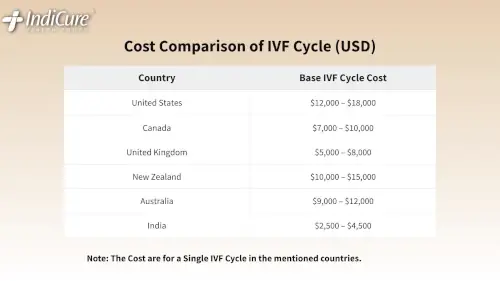
And for most people, one cycle isn't enough. On average, it takes about 2.3 to 2.7 IVF cycles to achieve a live birth. That pushes the total cost close to $50,000—more than double the price of a single cycle—and can consume nearly 41% of a family's annual disposable income.
For many families, these realities make choosing IVF treatment abroad the more achievable path forward.
A Step-by-Step Guide to IVF Treatment Abroad
Stepping into the unknown to build your family—thousands of miles from the familiar—is a journey fueled by incredible courage. To support you, we've cleared a compassionate path that carries the heavy lifting for you, turning a complex international journey for IVF treatment into a steady, gentle bridge to your new beginning.
Phase 1: Virtual Connection and Personalized Assessment
Your journey begins in the comfort of your own home, where your medical travel facilitator acts as your dedicated advocate. Rather than sending inquiries into the void, you are paired with a personal case manager who bridges the gap between you and world-class fertility specialists. Through private video consultations, you can discuss your history one-on-one with your doctor, ensuring a foundation of trust before you ever book a flight. By sharing your medical records—such as AMH reports and semen analyses—top embryologists can confirm your eligibility and craft a clinical protocol tailored specifically to your needs.
Here is what you will need at this stage -
- Medical Records: Digital copies of recent AMH reports, semen analysis, and any previous IVF cycle summaries.
- Video Consult Link: Confirmed date and time for your face-to-face meeting with the specialist.
- Questions List: A written list of concerns regarding protocols, medication, or success rates to ask during your consultation.
Phase 2: Seamless Logistics and Travel Coordination
Once you are medically cleared and confident in your plan, the focus shifts to the practicalities of your trip. Your facilitator handles the heavy lifting, providing the formal medical visa invitation letters essential for your application. From flight scheduling to selecting serene, serviced apartments near the clinic, every detail is managed to ensure you have a peaceful space to rest. Your entire itinerary is synchronized with your cycle, ensuring every appointment and baseline scan is perfectly timed.
Here is what you will need at this stage -
- Passport: Ensure it is valid for at least six months beyond your planned return date.
- Medical Visa (IV): Your formal invitation letter from the hospital (provided by your facilitator) to submit with your application.
- Flight & Stay Confirmation: Details of your hotel/serviced apartment and airport pickup instructions.
Phase 3: The Clinical Journey Abroad
Upon arrival, you are met with medical excellence that mirrors the highest international standards in JCI-accredited facilities. Your facilitator ensures a smooth transition from the airport to your first physical consultation. As treatment begins, you are closely monitored by experts through every milestone—from ovarian stimulation and egg retrieval to fertilization and embryo transfer—all within a supportive, state-of-the-art environment.
Here is what you will need at this stage -
- Comfortable Clothing: Loose-fitting clothes for post-procedure days and "waiting room" layers (clinics can be chilly).
- Prescription List: A list of any current medications you take daily.
- Digital Entertainment: Books, podcasts, or movies to help pass the time during the "two-week wait" or recovery periods.
- International Power Adapter: To keep your devices charged and stay connected with family back home.
Phase 4: Recovery and the Journey Home
The final stage is handled with the utmost delicacy. Your specialist monitors your progress after the transfer, ensuring you are medically stable and comfortable. Most patients are advised to rest for a few days before being cleared for travel. Even after you return home, the support doesn't end; your medical tourism facilitator coordinates telehealth follow-ups and shares necessary reports with your local doctor, ensuring a continuous circle of care as you begin your next chapter.
Here is what you will need at this stage -
- "Fit to Fly" Certificate: A signed document from your doctor confirming you are cleared for travel.
- Discharge Summary: A detailed medical report of the cycle to share with your doctor back home.
- Follow-up Schedule: Dates for your post-travel telehealth check-ins.
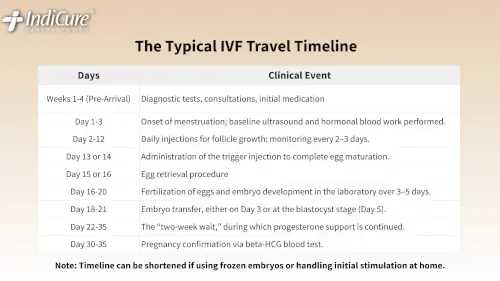
A typical timeline for seeking IVF treatment abroad looks something like this:
Selecting a destination for IVF treatment abroad:
Choosing the right destination country for IVF treatment abroad involves evaluating clinical expertise, legal frameworks, and success rates.
India: The Nexus of Technology and Compassion
IVF treatment in India has quietly become a global front-runner in fertility care, offering success rates that rival, and often exceed, top Western clinics at a fraction of the cost. For those exploring IVF treatment abroad, India brings together several powerful advantages in one place. Leading fertility centers in cities like Delhi, Mumbai, and Bangalore are equipped with world-class infrastructure, using advanced technologies such as RI Witness for secure embryo handling and AI-based embryo selection to improve implantation outcomes. This technical strength is matched by unmatched medical expertise, with many Indian fertility specialists internationally trained and highly experienced in managing complex cases that are often declined elsewhere.
Spain
Spain has become the go-to choice for many patients from the UK and across Europe, especially for those needing donor eggs. Its laws allow anonymous egg and sperm donation, which means access to a large donor pool and, importantly, no waiting lists. With egg donation success rates as high as 75-80 percent, Spain is often the preferred option for women of advanced maternal age looking for timely, reliable results.
However, the relatively higher costs for the procedure may still be a hindrance for many.
Mexico and Thailand
Mexico draws a large number of patients from North America thanks to its close proximity and inclusive laws that support LGBTQ+ individuals and single parents. Thailand, on the other hand, is popular for its high-end genetic testing and clear, all-inclusive treatment packages, making cost planning much easier for patients.
While Spain or Mexico may offer specific legal advantages, India remains the holistic "Good Quality, Affordable Costs" destination for IVF treatment abroad.
India remains the only destination that offers the trifecta of maximum cost savings (up to 70-80%), highest clinical technology, and seamless logistics through credible facilitators like IndiCure Health Tours. In India, you aren't just a number; you are treated with a level of warmth and personal attention that helps heal the emotional wounds of infertility while building the family you've always wanted.
Navigating the Legal and Ethical Considerations in India
When considering India for IVF treatment abroad, understanding the legal side of things is as critical as the medical care. India operates under a highly structured regulatory framework designed to protect patients, donors, and the resulting children. The Assisted Reproductive Technology (Regulation) ART Act, 2021 and the Surrogacy (Regulation) Act, 2021 have successfully streamlined fertility treatments to ensure safety and ethical transparency.
A vital point for international medical travelers is that commercial surrogacy is not available in India for foreign nationals. Under current law, surrogacy is restricted to altruistic arrangements solely for Indian citizens. This ensures that the focus of international medical travel to India remains on ethical, high-quality IVF and donor programs.
India remains an inclusive and well-regulated hub. Married heterosexual couples (who must provide a notarized marriage certificate) and single women, including widows and divorcees, are legally eligible to undergo fertility treatment. The law also sets clear age limits to ensure the health of both parent and child: women must be between 21 and 50 years old, and men between 21 and 55. Furthermore, the identity of egg and sperm donors is kept strictly confidential, though they undergo rigorous screening for medical and genetic conditions to ensure the highest clinical standards for your cycle.
Planning the IVF Journey in India with IndiCure
For those embarking on a journey to India for IVF treatment abroad, the role of a medical tourism facilitator like IndiCure Health Tours cannot be overstated. Navigating a foreign healthcare system, securing a medical visa, and coordinating between doctors on different continents is a complex task that adds to the existing emotional burden of infertility.
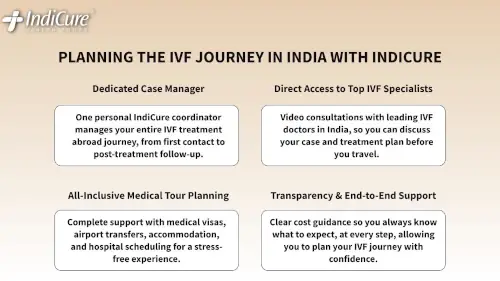
IndiCure functions as a bridge, managing every medical and medical travel logistical details to ensure a seamless experience. From the first inquiry, patients are assigned a dedicated case manager who facilitates the evaluation of medical reports by India's top fertility specialists.
This personalized approach extends to:
- Direct Access to Top IVF Specialists in India: Arranging video consultations with select top IVF doctors in India so patients can ask one-on-one questions before they fly.
- All-Inclusive Medical Tour Planning: Handling airport transfers, hotel bookings, and hospital arrangements, ensuring the patient never feels alone in an unfamiliar country.
- Transparency & End-to-End Support: Providing upfront, fixed-cost estimates to prevent financial surprises during the treatment journey.
By partnering with only JCI and NABH accredited hospitals, IndiCure ensures that the medical care received meets the highest international benchmarks for safety and clinical outcomes.
FAQs on IVF Treatment Abroads
-
Why is IVF treatment Abroad so much cheaper than in the U.S. or Australia?
The cost difference is largely due to lower operating expenses, including medical staff salaries, administrative overhead, and government subsidies in countries like India. Quality remains world-class because these clinics utilize the same technologies (ICSI, PGT-A etc) as Western centers.
-
Is it safe to fly back immediately after an embryo transfer done abroad?
Most doctors suggest a rest period of a few days following the transfer before taking a long-haul flight. Staying hydrated and moving around the cabin is recommended during the flight to ensure comfort.
-
How do I handle my follow-up care when I return home after IVF treatment abroad?
IndiCure remains available for post-operative consultations and coordinates with your home-country doctor for initial pregnancy blood tests (Beta-HCG) and early ultrasounds.
-
Can I undergo IVF treatment abroad as a single woman?
Yes, countries like India, Spain, and Mexico have favorable laws for single women seeking IVF with donor sperm. However, specific legal documentation may be required depending on the destination.
-
What if my IVF treatment abroad requires a second cycle?
Many patients find that even with two cycles abroad, the cost is still significantly lower than a single cycle at home. Facilitators like IndiCure often offer discounted "multi-cycle" packages for peace of mind.
-
Will my child have any legal rights to know the identity of a donor during IVF treatment abroad?
This depends on the laws of the country where the treatment occurred. Spain and India currently maintain donor anonymity, while other regions may offer "Open-ID" options.
-
Can I choose the gender of my baby during IVF treatment abroad?
Gender selection for non-medical reasons is prohibited in many countries, including India. However, it is permitted in certain jurisdictions like Northern Cyprus and Thailand under specific conditions.
-
What is the success rate for women over 40 seeking IVF treatment abroad?
Success rates with own eggs are lower for women over 40 (typically 5-10%), but using donor eggs can increase the success rate to over 60-75% regardless of age.
-
What are the hidden costs I should look out for while considering IVF treatment abroad?
Common "hidden" costs include specialized blood tests, extra days of medication, and storage fees for frozen embryos. Choosing an all-inclusive package through IndiCure helps minimize these surprises.
Final Insights and Conclusion
Choosing IVF treatment abroad can feel like taking control of your story when high costs and long waitlists back at home leave you stuck. With the right medical teams, modern clinics, and experienced medical tourism support guiding you at every step, the dream of parenthood through IVF treatment abroad starts to feel achievable again.
With the compassionate, hands-on guidance of IndiCure Health Tours, the focus remains on what truly matters: your hope, your healing, and the joy of building your family. Your dream of parenthood is no longer out of reach—let us help you bring it to life.


