


How MAKO Robotic Joint Replacement in India Empowers International Patients
Taking the first step is supposed to be simple, but for people living with chronic joint pain, even that can feel overwhelming. When your joints no longer move the way they used to, pain doesn't just affect your body. It slowly takes over your time, your social life, and the little moments you once enjoyed without thinking.
For many people in the United States, Canada, Australia, and New Zealand, the struggle doesn't end there. High healthcare costs or long waiting lists for surgery can make relief feel even further out of reach.
This is where hope starts to take shape. With advanced technology like the MAKO robotic system and the supportive guidance of IndiCure Health Tours, joint replacement is becoming more precise, more accessible, and far less intimidating. It's about combining innovation with genuine care, and helping people take that first step toward a pain-free life again.
The Silent Struggle of Chronic Joint Pain
To really understand why the MAKO robot matters, it helps to understand what daily life feels like with severe osteoarthritis or joint damage. It's waking up and waiting for your joints to "loosen up." It's that sharp pain when you stand from a chair. It's quietly saying no to a family event, a grandchild's wedding, or a simple walk in the park because your body just won't cooperate anymore. When doctors use the words "bone-on-bone," it often feels like the beginning of the end of independence.
For many patients in Western countries, the frustration goes even deeper. In the United States, learning that a robotic joint replacement could cost more than a year's salary, even with insurance, can feel crushing. In Canada and New Zealand, the challenge is different but just as painful. The solution exists, but the wait for surgery can stretch 12 to 18 months or more.
That waiting period puts people in a kind of limbo. You know help is possible, but it feels out of reach. And that takes a real emotional toll. Long waits often bring anxiety, low mood, and a steady drop in overall quality of life.
This is where the MAKO robot becomes more than just advanced technology. It represents a way forward. A way to skip the endless waiting, reduce uncertainty, and take control again. By choosing robotic joint replacement with a trusted partner like IndiCure, patients aren't just choosing a surgery. They're choosing to put their well-being first and reclaim a life they thought they had lost.
How MAKO Is Transforming Joint Replacement Surgery
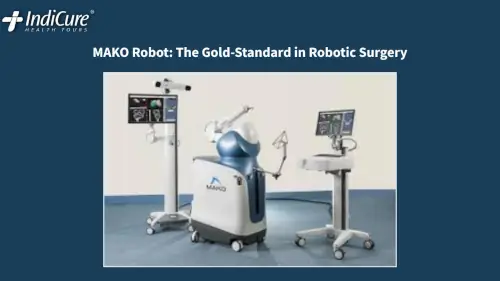
For years, joint replacement was about doing the best possible alignment by hand. Skilled surgeons relied on tools and experience, but everybody is different, and results could vary. MAKO robotic joint replacement changed that. By using SmartRobotics, it brings a new level of precision and consistency, helping joints feel more natural and last longer.
The Three Pillars of MAKO SmartRobotics
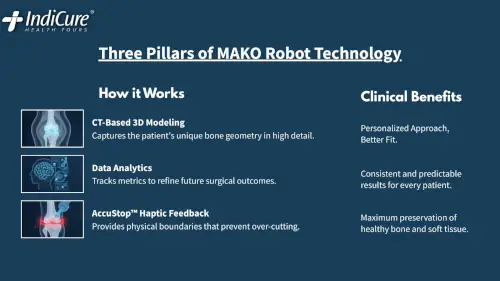
The three pillars of MAKO SmartRobotics combine advanced imaging, safety-focused hardware, and data-driven insights to deliver superior surgical results:
- 3D CT-Based Planning: This pillar begins before you enter the operating room. Using a detailed CT scan, the system captures your unique bone geometry to create a personalized 3D virtual model. This allows the surgeon to simulate the procedure in advance, ensuring the exact size, placement, and orientation of the implant are tailored to your specific anatomy.
- AccuStop™ Haptic Technology: During the procedure, the robotic arm acts as a high-precision guide for the surgeon. It creates "virtual boundaries" based on your pre-operative plan; if the surgical tool approaches the edge of these boundaries, the robotic arm provides tactile feedback or resistance to prevent it from moving outside the safe zone. This ensures that only the diseased bone is removed while healthy tissue and ligaments are meticulously protected.
- Insightful Data Analytics: This pillar focuses on ensuring consistent and predictable outcomes for every patient. The platform tracks and analyzes surgical metrics during and after the procedure, allowing surgeons to refine their techniques and continuously improve clinical results. This data-driven approach helps minimize complications and supports a faster, more reliable recovery.
Why Robotic Precision Outperforms Conventional Surgery
Every orthopedic surgeon hopes their patient reaches what is known as the "forgotten knee" or "forgotten hip"—a state where the patient is so comfortable and mobile that they completely forget they have an artificial joint. This is where the MAKO robot is transformative. Because it allows for sub-millimeter precision, the new joint is perfectly balanced with your natural ligaments and muscle tension, leading to a joint that feels more stable and natural during movement.
The Efficiency Gap: Robotics vs. Manual Techniques
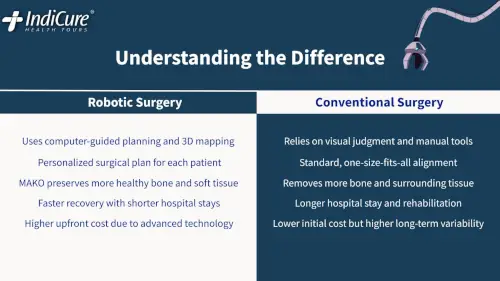
Conventional surgery relies heavily on the surgeon's visual assessment and manual tools, which can lead to alignment errors in complex anatomies. In contrast, robotic surgery utilizes computer-guided mapping that is up to five times more precise than manual bone cuts. While manual techniques are time-tested, they often involve more extensive tissue disruption and "one-size-fits-all" alignment. Robotic-assisted surgery is significantly more efficient in its execution of the surgical plan, minimizing intraoperative adjustments and reducing the overall trauma to the joint. This increased efficiency doesn't just improve the surgeon's performance; it directly preserves your healthy bone stock, building a stronger foundation that is especially critical for younger patients who may eventually require revision surgery.
Reclaiming Your Life in Weeks, Not Months: Rapid Recovery Milestones
The precision of the MAKO robot makes recovery feel faster and far less daunting. Most patients take their first steps within 24 to 48 hours after surgery. While traditional joint replacement can mean a hospital stay of 5 to 7 days, robotic surgery patients are often discharged in just 1 to 3 days. Many return to everyday activities within 3 to 5 weeks, compared to 6 to 8 weeks with conventional surgery.
Real patient stories bring this to life. Alan, 65, from the UK was walking hospital corridors within four days and reported "no pain at all." Cassandre Guinet from New Zealand, who underwent bilateral hip replacement in India, was mobile and exploring Mumbai just eight days after her second surgery. By minimizing blood loss and protecting soft tissues, MAKO helps reduce swelling, pain, and reliance on strong medications, making early recovery smoother and more comfortable.
Bridging the Financial Divide: World-Class Care at a Fraction of the Cost
For many international patients, choosing robotic surgery in India is both a medical and a financial decision. In most countries, robotic joint replacement is more expensive than conventional surgery because of the advanced technology, specialized equipment, and training involved. This often puts robotic surgery out of reach for many patients.
In the United States, a robotic joint replacement can cost between $35,000 and $70,000. In Canada and Australia, although public healthcare may cover conventional surgery, robotic options in the private system typically range from $15,000 to $30,000. New Zealand patients may face bills of up to $33,300 for robotic procedures.
In India, the same world-class robotic surgery costs between $7,000 and $11,000—offering savings of up to 80%, even compared to conventional surgery in Western countries. These lower costs are not due to compromised quality, but are driven by India's lower cost of living and its highly specialized, high-volume surgical centers.
India's Rise as a Global Destination for Robotic Surgery
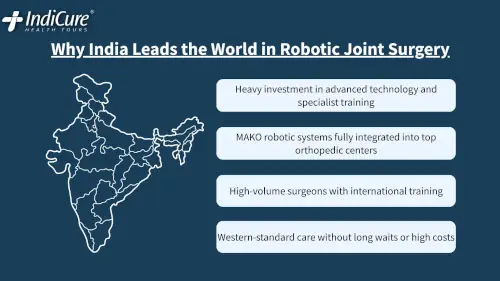
India's emergence as a leading destination for robotic surgery isn't by chance. It's the result of years of focused investment in advanced medical infrastructure and specialist training. Today, top private hospitals in India operate as true centers of excellence, welcoming patients from around the world who don't want to wait in pain or take on overwhelming debt just to regain their mobility.
World-Class Infrastructure and Accreditation
When patients come to India with IndiCure, they're not walking into anything unfamiliar or outdated. They're entering modern, five-star, JCI and NABH accredited hospitals that often look and feel more advanced than many Western facilities. Leading names like Wockhardt Hospital, Gleneagles Hospitals, and Fortis have fully integrated the MAKO robot into their orthopedic programs, with world-class operating rooms, strict infection control, and an exceptional focus on patient safety. For many, it's a pleasant surprise just how high the standards really are.

The Expertise of High-Volume Surgeons
With the MAKO robot, experience matters—and in India, orthopedic surgeons see more cases in a month than many Western surgeons do in a year. The surgeons IndiCure associate with are trained at top institutions in the UK, US, and Australia before returning to India to lead robotic surgery programs. Their international training means Western patients feel right at home, with no gap in professional standards or understanding.
The IndiCure Advantage: Empathy in Every Detail
Traveling halfway around the world for surgery with the MAKO robot can feel intimidating, and that's exactly where IndiCure Health Tours steps in. IndiCure isn't just about bookings or logistics. They act as a true medical concierge and patient advocate, making the entire journey feel calm, supported, and well thought out.
Empathy is at the heart of everything they do. IndiCure understands that patients are often in pain, feeling anxious, and unsure about overseas care. For MAKO robotic joint replacement, each patient is assigned a dedicated case manager who handles medical records, sets up video consultations with surgeons, and clearly explains costs upfront. No hidden fees, no last-minute surprises.
Their support goes far beyond the hospital. IndiCure assists with priority Indian Medical Visas, arranges local transportation, and stays available 24/7 on WhatsApp. Whether it's a medical question or a small comfort at an odd hour, help is always just a message away.
Frequently Asked Questions (FAQs)
-
How does the MAKO robot improve my surgical outcome?
The MAKO robot provides a level of precision that is impossible with the human eye alone. By using a 3D model of your joint, it ensures the implant is placed with sub-millimeter accuracy, leading to a more natural-feeling joint and a faster recovery.
-
Is the surgeon still in control during a MAKO robot procedure?
Absolutely. The MAKO robot does not perform the surgery. It is a highly sophisticated tool that the surgeon guides. The surgeon remains in total control, but the MAKO robot prevents any deviations from the personalized surgical plan through its haptic feedback system.
-
Is the lower cost of MAKO robotic surgery in India a sign of compromised technology or quality?
Not at all. The affordability of MAKO robotic surgery in India is a direct result of the country's lower cost of living and labor, and is not a reflection of medical standards. Top Indian hospitals utilize the same advanced Stryker MAKO platforms and high-quality, globally recognized implants found in the West. Furthermore, these facilities often hold JCI accreditation, adhering to international safety and sterility protocols that are identical to or often exceed those in the U.S. or Canada.
-
Can I have both joints replaced at the same time with the MAKO robot?
Yes, "bilateral" joint replacement is quite common for international patients who are in good health. Using the MAKO robot for both joints in one session can save you significant time and money on travel and recovery.
-
What are the main benefits compared to traditional surgery?
The primary benefits include greater surgical precision, better alignment of the new joint, smaller scars, and reduced blood loss. Because the technology preserves more healthy bone and soft tissue, patients often report less post-operative pain and a quicker return to daily life.
Conclusion: A New Chapter of Life is Within Reach
The MAKO robotic joint replacement has completely changed what's possible in joint surgery. Patients no longer have to settle for a “one-size-fits-all” approach. With robotic precision combined with expert surgical care, outcomes that once seemed impossible are now within reach.
For patients in the West feeling stuck in long waitlists or burdened by high costs, the MAKO robot paired with IndiCure Health Tours offers a real solution. It turns delays into action, debt into affordability, and fear into confidence. Chronic pain may have stolen your past, but with MAKO robotic joint replacement and IndiCure's full support, your future—and your independence—can be reclaimed. Every journey back to mobility starts with that first pain-free step, and IndiCure makes it safer, smoother, and more rewarding than you ever imagined.


