


The Seal of Excellence: What NABH Accredited Hospitals in India Mean for Your Surgical Journey
Choosing to travel halfway across the world for surgery is a monumental decision and the biggest hurdle is often not the distance; it is the uncertainty that comes with putting your health in unfamiliar hands.
When you start exploring healthcare options abroad, everything can sound “world-class” on the surface. But how do you really know what that means? How can you be confident that an operating theatre meets the same sterilization standards you expect back home, or that the surgeons and hospitals are monitored with the same level of accountability when they are thousands of miles away?
This is exactly where clear, trusted standards matter. To make a safe and informed choice in India, international patients should look for two widely respected “gold standards” of hospital accreditation: JCI (Joint Commission International) and NABH (National Accreditation Board for Hospitals & Healthcare Providers).
JCI is familiar to many as a globally recognized, U.S.-based benchmark for hospital quality. NABH, on the other hand, forms the backbone of India's own national framework for patient safety, clinical excellence, and hospital governance. Together, these accreditations remove guesswork and replace it with measurable proof.
In this guide, we focus specifically on NABH accredited hospitals in India. We break down what this certification actually means for your safety, why it is trusted around the world, and how IndiCure Health Tours uses these strict standards to carefully curate a surgical journey that feels secure, transparent, and reassuring from start to finish.
What exactly is NABH Accreditation?
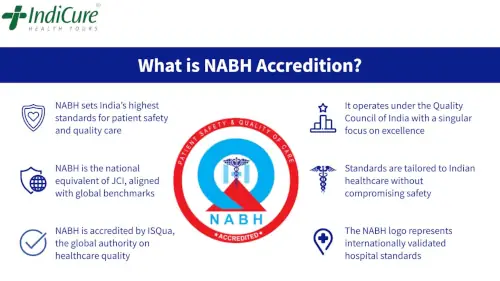
The National Accreditation Board for Hospitals & Healthcare Providers (NABH) is a constituent board of the Quality Council of India. It was established with a singular mission: to design and implement healthcare standards that ensure the highest level of patient safety and quality of care.
While many patients have heard of JCI (Joint Commission International), NABH is the rigorous national equivalent that has been tailored to the complexities of the Indian healthcare landscape while remaining aligned with international benchmarks.
The ISQua Connection: A Global Stamp of Approval
Crucially, NABH is a member of the International Society for Quality in Health Care (ISQua). This is a "who's who" of global health standards. This means that the criteria used to evaluate NABH accredited hospitals in India are fundamentally the same as those used in the UK, Australia, and the US.
When you see the NABH logo, you aren't looking at a local certificate; you are looking at a globally validated mark of quality.
The 10 Chapters of Patient Safety in NABH
To understand why NABH accredited hospitals in India are so reliable, we must look at the "Ten Chapters" of their accreditation process. These are the pillars that every hospital must prove they have mastered before they are granted accreditation.
-
Access, Assessment, and Continuity of Care (AAC)
This ensures that from the moment first contact is established with the hospital, there is a structured process. How is the patient admitted? How is the initial assessment conducted? Is there a clear plan for discharge and follow-up? There are established protocols for all these, thus preventing patients from "falling through the cracks."
-
Care of Patients (COP)
This is the heart of clinical care. It mandates standardized protocols for everything—from how anesthesia is administered to how high-risk patients are monitored. It ensures that the surgery isn't left to the whim of an individual doctor but is backed by evidence-based medicine.
-
Management of Medication (MOM)
Medication errors are a leading cause of hospital complications worldwide. NABH hospitals have strict systems for the storage, prescription, and administration of drugs. This includes "double-check" systems to ensure the patients receive the right dose of the right medicine at the right time.
-
Patient Rights and Education (PRE)
In a foreign country, you might worry about your voice not being heard. NABH standards protect your right to privacy, your right to an informed consent process (where all risks are explained), and your right to be treated with dignity regardless of your background.
-
Hospital Infection Control (HIC)
For a surgical patient, the greatest "invisible" threat is infection. NABH accredited hospitals in India must adhere to stringent sterilization protocols, air quality checks in operating theatres, and rigorous hand-hygiene audits.
-
Patient Safety and Quality Improvement (PSQ)
Accredited hospitals don't just "stay good"—they strive to get better. They must track "near misses" and adverse events to learn from them. This culture of constant improvement is what separates elite hospitals from average ones.
-
Responsibilities of Management (ROM)
This ensures that the hospital's leadership is ethical and that the facility is compliant with all national laws. It guarantees that the hospital is a stable, professional entity.
-
Facility Management and Safety (FMS)
This covers the "bricks and mortar." Is the backup power working? Is the medical gas supply secure? Are there fire safety protocols? In an NABH hospital, the infrastructure is as reliable as the surgeons.
-
Human Resource Management (HRM)
How do we know your nurse is qualified? NABH mandates verified credentials, ongoing training, and performance appraisals for every staff member. You are cared for by a team that is certified to be there.
-
Information Management System (IMS)
Your medical records are sensitive. NABH ensures that your data is kept confidential, accurate, and easily accessible for your future care back home.
Why Western Patients Prioritize Premium NABH Hospitals?
For patients traveling from the US, Canada, Australia, or the UK, the primary concern is often whether "affordable" healthcare translates to a compromise in quality. Choosing NABH-accredited hospitals in India eliminates this uncertainty by bridging the gap between Western clinical expectations and international reality. While you can save 70% to 80% on major procedures compared to the West, choosing an accredited facility ensures you are investing in "value-based" healthcare rather than merely "cheap" healthcare.
The "Same-Brand" Clinical Assurance
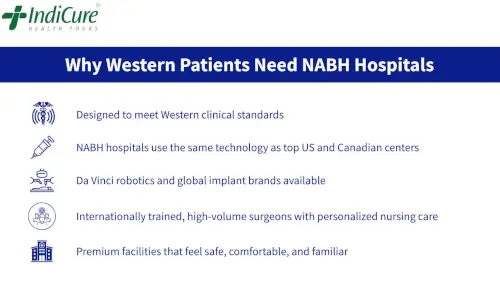
A common misconception is that lower costs imply "generic" equipment. In reality, NABH-accredited facilities utilize the exact same medical technology found at prestigious institutions like the Mayo Clinic or Cleveland Clinic. Whether it is a Da Vinci Robotic System for complex surgeries or Zimmer-Biomet implants for joint replacements, the hardware is identical to what you would find back home.
World-Class Surgeon Expertise
India's top surgeons often perform five times the volume of surgeries annually compared to Western doctors. Within the structured environment of an NABH-accredited hospital, this high volume translates to incredible precision. Furthermore, many of these specialists have spent decades practicing in the NHS (UK) or top US teaching hospitals, bringing a global perspective to their local practice.
The Premium Nursing & Care Model
Western patients are often pleasantly surprised by the level of bedside attention. While a nurse in the West may manage 8 to 12 patients, the premium wings of NABH hospitals maintain significantly lower ratios. This "boutique" care model feels more like a luxury hotel than a clinical ward, providing a level of personalized attention that is increasingly rare in overburdened Western systems.
Investing in Safety: The NABH Quality Guarantee
Think of NABH accreditation as your insurance policy for quality. In a vast healthcare market, the lowest quote often carries hidden risks. By choosing the "premium" tier of Indian healthcare, your investment goes directly into:
- Superior Infection Control: Rigorous sterilization protocols that minimize the risk of hospital-acquired infections.
- Advanced Infrastructure: Continuous investment in high-end diagnostic tools and robotic platforms.
- Qualified Personnel: A dedicated care team—from senior surgeons to specialized nurses—who undergo continuous credential verification.
- Ethical Billing: High standards of accountability that ensure transparent pricing and ethical medical practices.
The Verdict: While NABH-accredited hospitals are slightly more expensive than non-accredited local clinics, they provide a guaranteed baseline of safety and sophistication that "budget" options simply cannot match.
How IndiCure Health Tours Changes the Game
Choosing another country for surgery is a major decision and it is not one you should face alone. While hospitals manage the clinical side, the comfort and confidence of your journey depend on the human support around you. That is where IndiCure Health Tours makes the difference. We do not just share hospital options; our team is on the ground in India, helping with billing queries, coordinating second opinions, and offering reassurance when you need it most.
We work primarily in India's leading medical hubs such as Mumbai, Delhi, Hyderabad, Chennai, and Bengaluru because these cities are home to the best among NABH accredited hospitals in India. These facilities offer advanced technologies like robotic surgery, international-standard infrastructure, and surgeons with global training and experience.
Quality and safety are continuously monitored. NABH and JCI accreditations require regular renewal, and IndiCure partners only with hospitals that maintain active, up-to-date certifications. This ensures a consistent standard of hygiene, patient safety, and care, far above unverified or budget options.
Before you travel, we offer step by step guidance by arranging virtual consultations, providing transparent cost estimates, and reviewing your medical records to ensure you are ready. After surgery, we organize comfortable recovery stays, manage logistics, and support post-operative follow-ups. From planning to recovery, IndiCure stays by your side, making medical travel safer, smoother, and more reassuring.

Frequently Asked Questions (FAQ)
-
What is the process for an Indian hospital to achieve NABH accreditation?
Earning this certification is an intensive, multi-year commitment to quality. A hospital must demonstrate compliance with hundreds of "objective elements" across ten different chapters of patient care. This involves a gruelling 18 to 24-month period of internal audits followed by multiple on-site inspections by independent assessors. These experts scrutinize everything from clinical surgical outcomes and medication management to the technical safety of the building's infrastructure.
-
Are all hospitals in India NABH accredited?
No. There are thousands of hospitals in India, but only a fraction are NABH accredited. This is why you must be careful. IndiCure only recommends NABH accredited hospitals in India (or those with JCI accreditation) to ensure your safety.
-
How do NABH accredited hospitals in India handle my medical records?
Data security and continuity of care are central to the NABH framework. IndiCure utilizes secure, encrypted platforms to transfer your preliminary records for surgeon review. Once you arrive in India, NABH accredited hospitals in India follow strict Information Management System (IMS) protocols. This ensures your medical history, surgical notes, and diagnostic reports are accurately digitized, kept confidential, and handed over to you in a comprehensive format upon discharge to ensure your doctors back home have all the necessary information.
-
What about the "Superbugs" I've read about in the news?
Hospital-acquired infections are a risk in every country, including the US and UK. However, NABH accredited hospitals in India have strict infection control protocols in place and their infection rates are often lower than Western averages because they follow the HIC (Hospital Infection Control) chapter of their accreditation so strictly.
-
Is the food provided in NABH accredited hospitals in India safe for international patients?
Yes, patient nutrition and hygiene are strictly regulated under NABH standards. Most NABH accredited hospitals in India feature dedicated international patient kitchens designed to cater to Western palates. You will have access to continental, bland, or specific dietary menus—including gluten-free, vegan, or low-sodium options—all prepared under rigorous hygienic conditions to prevent any gastrointestinal issues during your recovery.
Conclusion: Your Health is Your Wealth
The time for waiting and financial worry has passed. The path to high-quality healing is open, and it leads directly to the elite NABH accredited hospitals in India. By selecting a facility that has met these rigorous, internationally recognized benchmarks, you are ensuring your surgery is performed with the precision and care that rivals the best centers in the West.
Choosing the right hospital from across the globe is a complex task, but you don't have to do it alone. With IndiCure Health Tours as your partner, you gain a dedicated advocate who ensures you access only the most reputable, premium facilities in India's leading medical hubs. We invite you to stop being a name on a waitlist and href="/contact-us/" target="_blank">start your medical journey as a person on the mend.


