


Debunking the Medical Tourism Myths: 7 Common Misconceptions About Surgery Abroad
The Weight of Waiting: Why Your Health Can't Wait for a Broken System
For millions of people in the United States, Canada, Australia, and New Zealand, the pursuit of basic healing has become an emotional and financial battlefield. We live in a world where healthcare spending in the U.S. has reached a staggering $14,885 per capita—nearly double the average of other wealthy nations. For the "cost desperate," medical bills are not just an occasional worry; they are a daily source of overwhelming stress. This stress is further exacerbated by the rise of medical tourism myths that paint the choice to seek care abroad as a dangerous gamble rather than the logical lifeline it truly is.
These are not just statistics; they are the heart-wrenching realities of patients being rejected by systems that prioritize bureaucracy over human suffering. Consider Stephen Foster from New Zealand, a kind-hearted man who was forced to live with chronic, agonizing knee pain while facing a "soul-crushing" 14-month waiting period in his home country. Or consider Thomas Young from the USA, an uninsured patient who faced the "unspeakable choice" between financial ruin and his personal health. In the U.S., Thomas would have paid five times more for his surgery than he eventually did by looking beyond his borders.
When domestic healthcare leaves you drowning in debt or trapped on a multi-year waiting list, looking beyond your borders is a rational, dignified response. However, the path to healing is often blocked by a wall of misinformation. These medical tourism myths—fears of inferior quality, unqualified doctors, or hidden costs—keep people in pain when world-class solutions are just a flight away. By systematically dismantling these medical tourism myths, we aim to restore your hope and show you that reclaiming your health is possible.
Myth 1: Separating Fact from Fiction About Quality in Medical Tourism Myths
The Myth: Many patients fear that because the cost of surgery in destinations like India is significantly lower, the quality of care must be unsafe or technologically inferior to Western standards.
The Fact: Quality in international healthcare is governed by rigorous, non-negotiable global benchmarks. The Joint Commission International (JCI) and the National Accreditation Board for Hospitals & Healthcare Providers (NABH) provide the gold standard for patient safety. JCI accreditation signifies that a hospital follows the same stringent clinical protocols—if not more advanced—than those found in the U.S. or U.K. For example, India boasts over 55 JCI-accredited hospitals equipped with state-of-the-art ICUs, advanced imaging technology, and robotic surgical systems. In these facilities, "lower cost" is a result of lower labor expenses and currency valuation, not a compromise on clinical excellence or sterilization protocols.
IndiCure's Mitigation: As stated above, though the healthcare system in India is very well equipped and safe, reputable healthcare facilitators like IndiCure double check and eliminate any risks associated with treatment of its medical tourists, and debunks these medical tourism myths by operating with a strict, non-negotiable vetting policy. We partner exclusively with hospitals that hold prestigious JCI, ISO, or NABH accreditations. By selecting only technologically advanced facilities that prioritize patient safety outcomes, we ensure our clients never have to worry about the validity of the care they receive. We don't just ask you to ignore the medical tourism myths; we provide the evidence-backed certifications that prove them wrong.

Myth 2: The Truth About Surgeon Qualifications
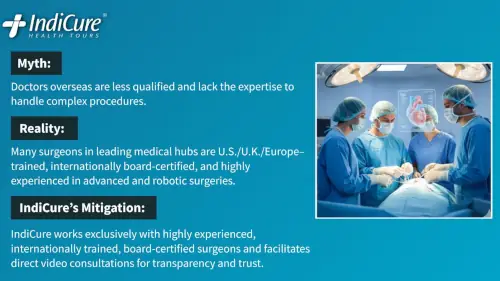
The Myth: There is a common misconception that doctors overseas are less qualified, lack Western training, or are not experienced enough to handle complex, life-altering procedures.
The Fact: This is one of the most persistent medical tourism myths. In reality, leading medical hubs like India are home to a global talent pool of recognized experts. Most senior surgeons at top-tier Indian hospitals have completed their residencies, fellowships, or specialized training at prestigious institutions in the U.S., U.K., or Europe. Most are board-certified and hold memberships in international bodies like the American College of Surgeons. Furthermore, because these hospitals handle a high volume of international cases, their surgical teams often have more "hands-on" experience with complex robotic surgeries and minimally invasive techniques than their Western counterparts.
IndiCure's Mitigation: To bridge the trust gap created by these medical tourism myths, we facilitate direct communication. We offer video consultations that allow you to speak one-on-one with your board-certified surgeon before you even book a flight. This transparency allows you to discuss your medical history and specific surgical plan, building the critical patient-physician trust that these medical tourism myths try to undermine. We believe that seeing the surgeon's credentials and expertise firsthand is the best way to dismantle these medical tourism myths.
Myth 3: Medical Travel is Only for Aesthetic Surgeries
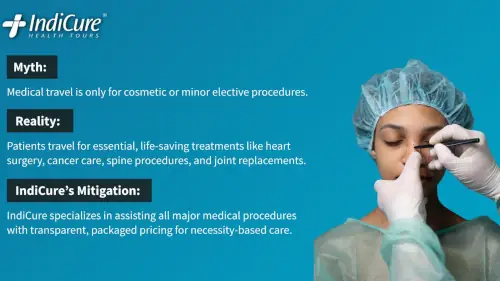
The Myth: Many believe that medical travel is only relevant for minor elective procedures like "smile makeovers" or aesthetic surgeries, making it an unsuitable option for serious medical needs.
The Fact: While cosmetic and dental tourism are popular, the real growth in the industry is driven by medical necessity. Patients are increasingly traveling for complex, life-saving interventions such as heart bypass surgery, heart valve replacements, spinal fusions, cancer treatments, and major orthopedic joint replacements. In the face of a $123,000 heart bypass in the U.S., a $5,900 procedure in a world-class Indian hospital is not about vanity—it is about survival. These medical tourism myths fail to account for the thousands of patients who reclaim their mobility and health through non-cosmetic, critical surgeries every year.
IndiCure's Mitigation: We combat these medical tourism myths by specializing in a broad range of life-changing specialties, including orthopedics, cardiology, and oncology. We provide transparent, packaged pricing for these major surgeries, ensuring that patients seeking necessity-based care have a clear, affordable roadmap. By focusing on essential healthcare, we prove that medical tourism myths limiting the scope of care are entirely unfounded.
Myth 4: The Financial Reality and Hidden Costs in Medical Tourism
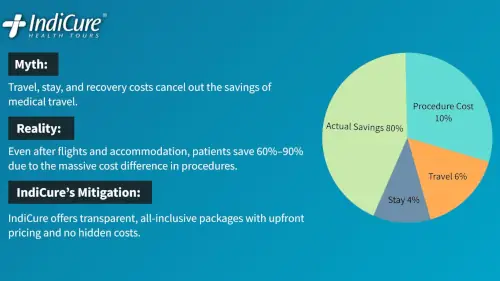
The Myth: Skeptics often claim that once you factor in flights, hotels, and recovery time, the cost savings of medical travel vanish, leaving the patient with no real financial benefit.
The Fact: The monumental gap in procedural costs between the West and top medical destinations ensures that net savings remain enormous. When a heart bypass costs $123,000 in the U.S. and $6,000 in India, the savings of over $117,000 easily absorb all travel and accommodation expenses, as these expenses do not amount more than $ 2000-4000. Patients consistently realize net savings of 60% to over 90%, even after including luxury recovery stays and airfare. These medical tourism myths about "hidden costs" simply do not stand up to the math of the global healthcare market.
IndiCure's Mitigation: We eliminate the uncertainty of these medical tourism myths by providing all-inclusive, transparent quotes. Our packages cover the surgery, hospital stay, surgeon fees, airport transfers, and local accommodation. By presenting the total cost upfront, we ensure there are no surprises, allowing you to focus on your recovery instead of worrying about the financial misinformation spread by common medical tourism myths.
Myth 5: Limitations of Insurance in Medical Tourism
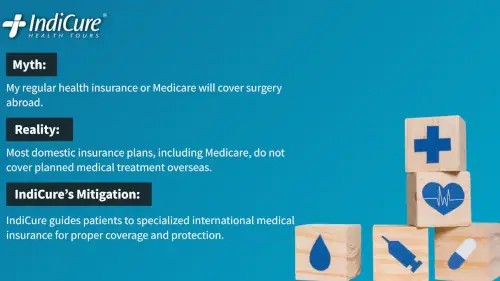
The Myth: Patients often assume their standard health insurance or Medicare will cover them if they decide to have surgery abroad, leading to a false sense of security.
The Fact: This is a dangerous misconception within the world of medical tourism myths. In reality, U.S. Medicare and Medicaid do not pay for medical care outside the United States, and most Canadian provincial plans cover only a tiny fraction of international costs. Domestic insurance is almost never "portable" for elective procedures abroad. Relying on your home-based policy for a planned surgery in India is a gamble that these medical tourism myths dangerously encourage.
IndiCure's Mitigation: We advise our clients on the necessity of specialized coverage. We guide you toward procuring comprehensive travel medical insurance that explicitly covers international hospitalization and emergency medical evacuation. By addressing the insurance gaps highlighted by these medical tourism myths, we provide a safety net that domestic plans cannot offer, ensuring your financial and physical safety are protected.
Myth 6: Managing Infection Risks and the "Safe" in Medical Tourism
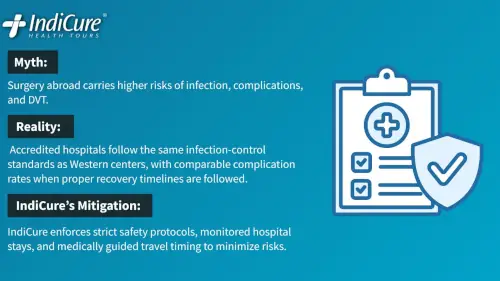
The Myth: There is a pervasive fear that the risk of post-surgical complications, infection, and deep vein thrombosis (DVT) is significantly higher when traveling for surgery.
The Fact: Is medical travel safe? Absolutely Yes, since safety depends on protocols, not geography! While surgery always carries risks, accredited international hospitals follow the same infection control standards as Western facilities. The risk of DVT from flying is minimized by ensuring that patients do not fly too soon after surgery and follow a monitored recovery timeline. Clinical data shows that complication rates in JCI-accredited facilities in top medical tourism destinations like India, are well comparable to top Western centers. These medical tourism myths about rampant infection ignore the high-level hygiene and sterilization technology utilized in modern medical hubs.
IndiCure's Mitigation: We address the concerns of these medical tourism myths by enforcing strict safety protocols. We require a minimum 24-hour hospital stay after any major operation to ensure intensive monitoring by a 24-hour nursing team. We also educate patients on the necessary recovery window before flying, ensuring they avoid the DVT risks mentioned in medical tourism myths. By prioritizing clinical safety, we provide an evidence-based answer to the question: is medical travel safe?
Myth 7: Communication Barriers in Medical Tourism
The Myth: The fear of being "lost in translation" or having no follow-up care once you return home makes many patients believe that medical travel is too administratively risky.
The Fact: This is one of the most easily debunked medical tourism myths. In major medical hubs like India, English is the primary language of the medical sector. Doctors and nurses are fluent, and hospitals dedicated to international patients have specialized departments to coordinate every administrative detail. Furthermore, modern telemedicine allows for robust post-operative follow-up, ensuring that "informational continuity" is maintained even after the patient returns home. These medical tourism myths fail to recognize the sophisticated relational support already in place for global patients.
IndiCure's Mitigation: We solve the "informational gap" created by these medical tourism myths by facilitating the seamless transfer of medical records in English. Our team remains your point of contact for follow-up consultations and addresses any concerns until you are fully recovered and settled back home. We bridge the relational divide that medical tourism myths warn about, ensuring you are never left without support.

Conclusion: Your Game-Changer in Defeating Medical Tourism Myths
Ultimately, the goal of dismantling these medical tourism myths is to provide you with the freedom to choose health over suffering. You do not have to be a victim of a system that imposes years of wait times or six-figure medical debts. The evidence clearly shows that when you look past the medical tourism myths, you find a world of accredited hospitals, board-certified surgeons, and transformative savings.
IndiCure serves as your trusted partner, providing the essential infrastructure to navigate the clinical and logistical complexities of surgery abroad. By vetting hospitals for JCI standards, facilitating video consultations, and managing all airport and accommodation logistics, we transform a daunting process into a professional, coordinated journey. The "IndiCure Advantage" is about replacing the anxiety of medical tourism myths with the security of expert care. Do not let medical tourism myths keep you in pain—take the first empowering step today by requesting a consultation and reclaim the healthy, vibrant life you deserve.
Frequently Asked Questions (FAQ)
-
What are the most common medical tourism myths regarding safety?
The biggest medical tourism myths suggest that lower costs mean inferior care. In reality, safety depends on several factors like hospital accreditation (like JCI or NABH), the skill of board-certified surgeons, how well is the treatment planned and whether it is administered in a timely manner or not.
-
Is medical travel safe for complex surgeries like heart bypass?
Certainly Yes. India is a global hub for complex surgeries, offering advanced technology like robotic systems and specialized ICUs that meet international safety standards.
-
Will I be able to communicate with my doctors?
Yes. English is the official language of medical instruction in India, and most senior doctors have worked or trained in the U.S. or U.K. or other Western countries.
-
How much can I really save despite travel costs?
Savings typically range from 60% to 90%. For example, you can easily save over $115,000 on a heart bypass surgery compared to U.S. prices.
-
Does standard insurance cover international surgery?
Generally, no. Medicare, Medicaid, and Canadian provincial plans rarely cover elective international treatment.


