


From a Wheelchair in Feilding to Walking Again in Mumbai: Karolyn's Spine Surgery in India
Written By:
 Anjana Singaraju
Medically Reviewed By:
 Dr. Mazda Turel, M.B.B.S; M.Ch. Neurosurgery
Published On : Sep 25, 2026
Edited On : Sep 25, 2026
Tag : Spine Surgery
Thirteen years of being told to wait
Karolyn's pain began with an ordinary accident. In 2012, a fall during pregnancy left her with hip pain. As she told New Zealand Woman's Weekly, she was advised to lose weight and expect the pain to settle. She lost the weight. The pain stayed.
It took until 2021 for her to receive a microfracture repair to her hip. For about eighteen months, life improved. Then she tore her hip capsule, and her back began compensating for a joint that was no longer doing its job. A month later, lifting a heavy bag of animal feed on the family's 10-hectare lifestyle block, she felt something give way in her lower back. The pain that started that day never left.
Imaging eventually explained why. Two of her lumbar vertebrae had lost the cartilage between them and were grinding bone on bone. She had pars fractures — stress fractures in a small bridge of bone at the back of the vertebra — and one vertebra had slipped forward out of alignment, a condition called spondylolisthesis. It is a close cousin of the slipped disc most people have heard of, but mechanically more serious, because the bone that holds one vertebra in place over the next has failed. A second hip operation did nothing for her back.
By 2024, Karolyn was taking as many as 40 painkillers a day, including high doses of morphine, and still could not leave the house without a wheelchair. She could not work. She could not care for the donkeys, peacocks, turtles, dogs and swans on the property, or homeschool her 12-year-old son Lucas, the way she wanted to. Her husband Andrew and her five adult children carried the household.
When the system at home says NO
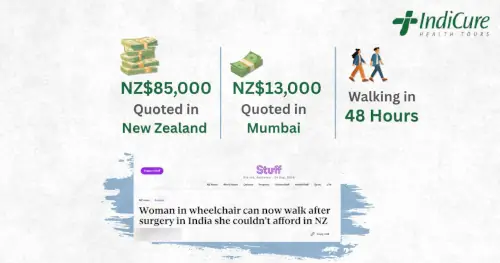
This is the part of Karolyn's story that resonates with many New Zealanders. ACC declined to cover her surgery. She and Andrew looked at drawing down their KiwiSaver to fund a private spinal fusion in Wellington, quoted at roughly NZ$85,000. The operation described to her was an open procedure requiring the surgeon to work through her abdominal and back muscles, followed by a long recovery. And after all that, the surgeon she consulted told her he did not believe it would give her the result she wanted.
That is a brutal place to be: too injured to live normally, not eligible for public cover, and unconvinced by the only private option on the table.

Finding a second opinion 12,000 km away
Karolyn found IndiCure while searching for alternatives, and through us was connected with Dr Mazda Turel, a brain and spine surgeon at Wockhardt Hospitals in Mumbai Central. Her reports and scans were reviewed, and a written opinion came back: her problem was structurally fixable, and it could be addressed with minimally invasive techniques rather than a large open exposure.
She has since described that first conversation as the turning point — the first time in years that a surgeon told her plainly that an operation would work, and gave her a reason to believe it.
Two weeks later she was in Mumbai.
The operation
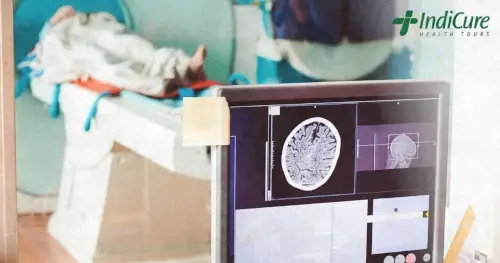
Dr Turel's team re-examined her and repeated imaging on arrival to confirm the diagnosis before committing to a plan. She then underwent a minimally invasive lumbar fusion with decompression.
In plain terms, four screws were placed to stabilise the affected vertebrae, working through small incisions rather than a long open cut. A titanium cage packed with bone graft was inserted into the collapsed disc space to restore height and allow the two vertebrae to fuse into one solid unit. The slipped vertebra was repositioned, and the compressed nerves were freed.
The point of doing this using a minimally invasive technique with neuro-navigation is quick recovery and precision. Screw placement in a spine with fractured pars and altered anatomy is unforgiving, and navigation lets the surgeon plan and verify each trajectory against live imaging. Combined with a muscle-sparing approach, that generally means less blood loss, less post-operative pain and a faster return to walking than a traditional open fusion.
The results in Karolyn's case were quick. She was helped to stand the following day and was startled to find the pain gone. Within 48 hours she was walking the ward corridors and climbing stairs — something she had not managed in more than 18 months.
The surgery took place on Christmas Eve 2024. Six days later she was cleared to fly. She walked through her own front door on New Year's Day, and her son's reaction has become the family's favourite retelling of the whole ordeal — he told her to sit down, and she answered, "No, I can walk!"
Hers is not an isolated case. Christopher Sierzant, a US athlete with a damaged disc, came to India rather than face the American system and was back to an active life a fortnight after surgery — his account and others are here.
What it cost, and why the gap is that large
Karolyn has said publicly that the surgery in India cost her around NZ$13,000, against the NZ$85,000 she was quoted at home.
That gap is not a discount on quality. Indian private hospitals accredited by NABH and JCI use the same implant manufacturers, the same imaging platforms and the same navigation systems as hospitals in Australasia. The difference is in the underlying cost base — staffing, real estate, insurance overheads and the price of medical education — not in the hardware going into the patient or the training of the surgeon holding the instruments. We have set out the components of that pricing in detail on our spine surgery cost page.
A note on numbers: the figures above are what Karolyn reported to New Zealand media in 2025. They are not a price list. Spinal fusion in India starts from around USD 4,500, and your own cost depends on the number of levels fused, the implants used, whether navigation is employed, your length of stay and your fitness for surgery. IndiCure does not charge patients a facilitation fee — we are paid by the partner hospital — and we pass on the hospital's quotation unaltered so you can see exactly what you are paying for.
Where Karolyn is now
She still has to be sensible about her back. But she attends regular gym sessions through Sport Manawatū's Green Prescription programme, line dances twice a week, and has completed a nail technician course and started a small business from home.
She has been open about why she keeps telling the story: she has already spoken to three other people living with chronic pain about what she did, and considers that reason enough.
Is travelling for spine surgery right for you?
It genuinely is not for everyone. Realistically, you are a reasonable candidate if:
- You have a structural diagnosis on imaging — instability, slippage, stenosis, a fracture — rather than pain without a clear mechanical cause.
- You have already been assessed at home and understand what was offered and why it was declined.
- You are otherwise medically fit.
- You have a plan for follow-up and physiotherapy in your own country.
Frequently asked questions
1. How much does spinal fusion surgery cost in India?
Costs are typically a fraction of private prices in New Zealand, Australia, the UK and Canada. Spinal fusion in India starts from around USD 4,500. Karolyn Carroll reported paying around NZ$13,000 for a minimally invasive lumbar fusion and decompression for multiple levels in Mumbai in December 2024, against an NZ$85,000 private quote at home. Your quote depends on levels fused, implants and length of stay; ask for it in writing before you travel.
2. How long do I need to stay in India for spine surgery?
Plan for roughly 10 to 14 days in total for a single- or double-level lumbar fusion — a few days for assessment and pre-operative workup, three to five days as an inpatient, and a review before you are cleared to fly. Karolyn flew home six days after her operation, which is at the faster end.
3. Is robot-assisted spine surgery available in India?
Yes. Robotic and navigation-guided spine platforms are in routine use at major private hospitals in Mumbai, Delhi, Chennai and Bengaluru, including Wockhardt Hospitals, Mumbai Central, where Karolyn was treated. You can see the surgeons we work with on our best spine surgeons in India and best neurosurgeons in India pages.
4. What happens if something goes wrong after I get home?
Ask this question before you book any facilitator. You should leave India with your full operative note, implant details, discharge summary and imaging, and a named point of contact for your surgeon. IndiCure coordinates post-discharge questions between you and the operating surgeon at no cost.
5. Can I claim this back from ACC or my insurer?
Depends on your insurer and policy. ACC does not generally fund treatment obtained overseas without prior approval, and most private health policies exclude elective overseas surgery. Check with your insurer before you travel rather than after.
Talk to us: If you are living with a spinal condition and have been told to wait, or been quoted a figure you cannot fund, send us your MRI or CT report and a summary of your diagnosis. We will get it in front of a spine surgeon and come back with a written opinion and an itemised hospital quotation, at no cost and with no obligation.
Karolyn Carroll's story was first reported by Annemarie Quill for Stuff (14 July 2025) and by Kasia De Vydt-Jillings for New Zealand Woman's Weekly (28 August 2025); the print feature is also available via Magzter. Photography © Are Media / Bernadette Peters, not reproduced here. Published with the patient's consent.
This article describes one patient's experience and is for general information only. It is not medical advice, and it is not a promise of a similar outcome — surgical results depend on your individual diagnosis, anatomy and general health. Always discuss your options with a qualified surgeon before making treatment decisions.


