


Robotic Bilateral Knee Replacement in India: Karen's Story from New Zealand
Key Takeaways
- Karen, a 66-year-old former international athlete from New Zealand, had both knees replaced in one operation in Mumbai.
- She avoided a wait of around three years at home, and her surgery took place the day after her consultation.
- Dr. Mudit Khanna used MAKO robotic technology and a muscle-sparing (subvastus) approach.
- She spent 9 days in hospital and 20 days in India in total, and travelled alone with support from IndiCure.
Karen Brown spent around 15 years playing hockey and cricket at international level. Decades later, her knees were paying the price. Pain, swelling and locking had made walking difficult, and cortisone injections no longer helped. At home, she was facing a wait of around three years for surgery.
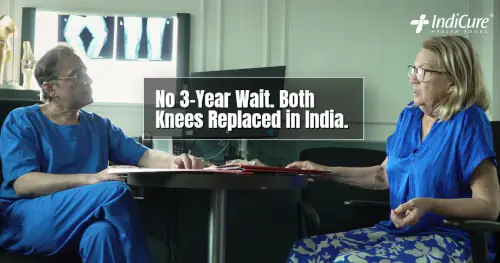
In September 2026, the 66-year-old flew alone from New Zealand to Mumbai and had both knees replaced in a single surgery, using MAKO robotic technology with orthopaedic surgeon Dr. Mudit Khanna. Here is her journey, step by step, and what it means for anyone considering robotic knee replacement in India.
Meet Karen: A Lifelong Athlete Whose Knees Needed Help
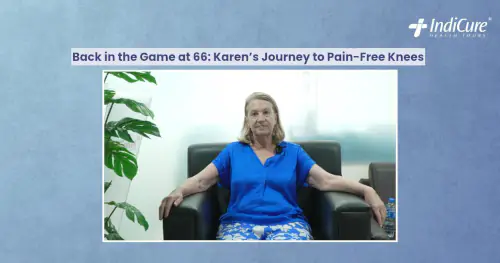
Karen had been active all her life. Years of competitive sport, however, took a toll on the knee joints.
Her right knee was the main problem. It was painful and swollen, she could not straighten it fully, and it would sometimes lock, stopping her mid-step. Her left knee had already needed a meniscectomy in 2021, an operation to remove part of the cartilage cushion inside the joint. Cortisone injections had not given her any lasting relief.
In Karen's words: "I wasn't prepared to put my life on hold any longer and wanted to be the active, healthy person that I normally am."
Why Karen Chose India Over a Three-Year Wait at Home
Karen chose India for two reasons: the cost of knee replacement in New Zealand was out of reach, and the public waiting list would have kept her waiting for years.
- No waiting list: surgery the day after her consultation, instead of a wait of around three years
- Affordable care: treatment within reach, compared with the cost of private surgery at home
- An experienced surgeon: Dr. Khanna trained in the UK and USA, and Wockhardt Hospitals reports that he has performed more than 8,000 joint replacements.
- Both knees in one trip: robotic, muscle-sparing surgery on both knees, one hospital stay, one recovery
In Karen's words: "The reason that I chose to come overseas is because in my country the costs of getting the type of surgery that I required are prohibitive, and there is also a huge waiting list. I wasn't prepared to wait for three years, which I would have to have in New Zealand."
Five Months of Planning, From New Zealand
Karen first contacted IndiCure on 1 April 2026. Her case manager, Dr. Prerana collected her X-rays and medical history and shared them with Dr. Mudit Khanna for review before any travel was booked.
Over the next five months, the IndiCure team arranged her consultation, hospital admission, travel dates and all airport and local transfers as part of an all-inclusive package. She landed in Mumbai just after midnight on 8 September and met Dr. Khanna the same day.
The Treatment Plan: Why Both Knees Were Replaced Together
Dr. Khanna recommended a bilateral total knee replacement - both knees in one operation - on 9 September 2026, the day after her consultation.
Replacing both knees together means one anaesthetic, one hospital stay and one rehabilitation period. For an international patient, it also means one trip instead of two. It is not right for everyone, though; it is offered only when a patient's overall health allows it. Replacing both knees at once is more demanding than a single knee replacement, so it is offered only after a careful health assessment.
How Robotic, Muscle-Sparing Surgery Works
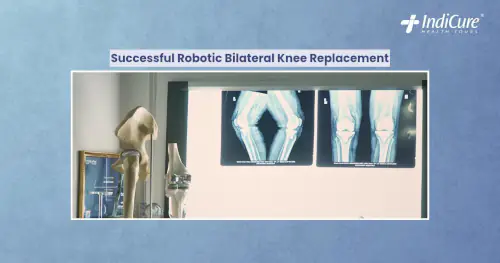
Before surgery, a CT scan is used to create a 3D plan of each knee. During the operation, the MAKO robotic arm helps the surgeon follow that plan precisely, while the surgeon stays in control throughout. Robotic assistance can improve the precision of implant positioning, but long-term results also depend on the surgeon's skill, the patient's health and rehabilitation. Your surgeon will advise whether robotic surgery is right for you.
Dr. Khanna used a subvastus approach, reaching the knee from underneath the quadriceps muscle without cutting the quadriceps tendon. This muscle-sparing approach is intended to reduce disruption to the thigh muscle, and your surgeon will explain whether it suits your knee.
To learn more about how the procedure works and what recovery involves, see the American Academy of Orthopaedic Surgeons' patient guide to total knee replacement.
Twenty Days in Mumbai: Hospital, Physiotherapy and Support
Karen spent nine days in hospital after surgery and was discharged on 18 September. She stayed in Mumbai for another ten days, continuing physiotherapy and attending her review, before flying home on 28 September.
- Hospital stay: daily physiotherapy to get both knees bending and to start walking safely
- After discharge: follow-up review and continued rehabilitation before being cleared to fly
- Local support: all transfers included, with Dr. Prerana and her team a phone call away - especially important for a patient travelling alone
In Karen's words: "I was fully supported right from the time of my arrival, and was taken to the hotel and brought to the hospital, and looked after extremely well."
Karen's Advice to Other Patients
Karen travelled alone, and what stayed with her most was how safe she felt. Her message to anyone weighing up surgery abroad:
In Karen's words: "I was very impressed with the professionalism, and how they just made me feel welcome and safe and secure. I can only highly recommend IndiCure and the medical tourism that takes place in this country. It's wonderful."
Video summary: In this video, Karen Brown, a 66-year-old former international hockey and cricket player from New Zealand, explains why she travelled to India for robotic bilateral knee replacement. She chose not to wait about three years for surgery at home, and found the cost of private treatment there prohibitive. She describes being supported from the moment she arrived in Mumbai, being taken to her hotel and the hospital, and feeling welcome, safe and secure while travelling alone.
Planning a Knee Replacement in India?
Every patient's plan is different. If you are considering a robotic knee replacement or orthopaedic surgery in India, you can explore our list of top orthopedic surgeons in India, and start with a free assessment, share your X-rays and medical history, and our team will connect you with an experienced joint replacement surgeon and a clear, personalized plan.
Get a Free Quote · WhatsApp Our Team
Read another patient story: Roger's Story of Both Hip Replacement in India with IndiCure.
Frequently Asked Questions
It can be, when surgery is done by an experienced joint replacement surgeon at an accredited hospital, after a proper pre-operative assessment and with a clear rehabilitation plan. Like any major surgery, knee replacement carries risks, so check the surgeon's training and the hospital's accreditation, and discuss the risks with your surgeon before you travel.
Yes. Karen travelled alone from New Zealand. With a dedicated case manager, airport transfers and hospital support arranged in advance, many patients travel without a companion, though some choose to bring one. Your surgeon will advise whether you need someone with you after a bilateral knee replacement.
Yes, in suitable patients. A bilateral knee replacement means one surgery and one recovery period, but it is more demanding on the body, so your surgeon will assess your overall health first.
Plan for about three weeks, though your surgeon will confirm the length of stay for your case. Karen spent nine days in hospital and ten more days in Mumbai for physiotherapy and review before flying home.
Typically, your consultation, surgery, hospital stay, physiotherapy in hospital, and airport and local transfers. Inclusions vary by case, so ask for a written, itemized quote.
The cost depends on whether one or both knees are replaced, the implant, the hospital and the length of stay. Robotic knee replacement in India starts from USD 6,430 for one knee and USD 10,750 for both knees, though your quote depends on your case. See our Knee Replacement Cost in India guide, or send your X-rays to IndiCure for a free, personalised quote.
In our experience, most IndiCure patients are cleared to fly about two to three weeks after a bilateral knee replacement, once the wounds are healing, they can walk safely and the surgeon has reviewed them. Your surgeon will also advise on preventing blood clots during the flight, such as moving regularly, wearing compression stockings and, if prescribed, taking blood thinners.
Robotic assistance helps the surgeon plan and position the implant to a pre-set plan, which can improve the precision of implant positioning. Both robotic and conventional knee replacements can give good results in experienced hands, and the right choice depends on your knee and your surgeon's advice.
How We Support Your Treatment Journey
We handle every detail of your trip so you can focus entirely on your health and recovery:
- Pre-Trip Medical Reviews: Getting expert clinical evaluations before you travel.
- Visa & Travel Support: Handling your medical visa paperwork and logistics.
- Comfortable Stays: Arranging vetted accommodations tailored to your recovery needs.
- Coordinated Care Journey: Managing every step from your first consultation to post-treatment follow-up.


