Fertility Tourism in India: Your Guide to Hope and Parenthood
Acknowledging the Emotional & Psychological Journey
The dream of having your own child is one of the most fundamental human desires. When this dream is met with the silent struggle of infertility, it can trigger a deeply personal and often isolating emotional journey. For many, this path is a relentless emotional roller coaster of building hope, enduring uncertainty, and facing devastating losses with each negative result or failed cycle. This is not merely a clinical condition; it is a profound life event marked by immense psychological distress. The pain of watching others effortlessly start families, especially on social media, can intensify feelings of comparison and envy, making one's own journey feel even more lonely and difficult. For some, exploring options like fertility tourism in India offers not only advanced medical solutions but also a renewed sense of hope and accessibility in the face of these struggles.
Healing through this storm requires more than just medical intervention; it demands a significant shift in perspective. For some people the grief of ending treatment without a child stays with them for a long time, and that is worth naming rather than glossing over. Fertility treatment is demanding emotionally as well as physically, and support through it matters in its own right - not because distress is something you have to fix before treatment can work. This intricate link between emotional well-being and physical health underscores that the journey is not just about the medical procedure itself but about finding emotional balance and building resilience. The goal is to move forward with hope, armed with the compassion and self-kindness needed to navigate the unknowns.
The Global Pursuit: Why Look Beyond Your Borders?
The decision to seek fertility treatment outside one's home country is rarely a casual one. It is a choice born from the need to overcome significant systemic and societal barriers. The underlying reasons for this global pursuit are varied, yet deeply personal, reflecting the unique challenges faced by different populations.
For patients in Western nations, the primary catalysts are often a matter of finance and time. A single cycle of In Vitro Fertilization (IVF) in the United States, for instance, can cost upwards of $15,000, and with additional costs like medication, the total can exceed $20,000. On top of that, the initial quote does not include the cost of injectable hormones, which typically ranges from $ 5000 to over $ 8000. In addition, clinics may charge extra fees for services such as intracytoplasmic sperm injection (ICSI), genetic testing of embryos, a trial or “mock” embryo transfer, and cryostorage for embryos you choose to preserve, making the overall costs go up to $ 35,000-40,000 in some cases!
This is a price point that makes a dream of parenthood financially impossible for many. Beyond the prohibitive cost, patients in countries like the USA and the UK frequently face long waiting times for appointments or for donor gametes, which can stretch for months or even years. For women, where age is the most critical factor for success, these delays can have a direct and negative impact on their chances of conception. Faced with these seemingly insurmountable obstacles, looking abroad becomes a viable and logical alternative.
Conversely, for patients in many African countries, the challenge is not just the high cost but a fundamental lack of access and infrastructure. The financial burden is even more acute; with local currency devaluations, the average cost of an IVF cycle can be equivalent to more than a year's salary for a middle-class worker, forcing families to sell land or other assets to afford a single attempt. Compounding this are deep-seated cultural beliefs and pervasive social stigma, which can place the entire blame for infertility on the woman, leading to intense social isolation. Therefore, for many in Africa, fertility tourism is not merely about finding a more affordable option; it is about finding a dignified, accessible, and supportive pathway to a solution that is simply unavailable at home.
Why India: What It Offers
Fertility tourism in India is a rising trend as it offers a powerful combination of affordability, cutting-edge technology, and world-class medical expertise. India's rise as a medical tourism hub is rooted in an IVF ecosystem that provides a compelling solution to the very challenges that drive patients to seek care abroad.
A major draw is the dramatic cost-effectiveness of fertility procedures in India. The price of an IVF cycle in India is a fraction of what it costs in Western countries, even when factoring in travel, accommodation, and other expenses. This is made possible by lower operational costs and a competitive market, at clinics that work to international standards.
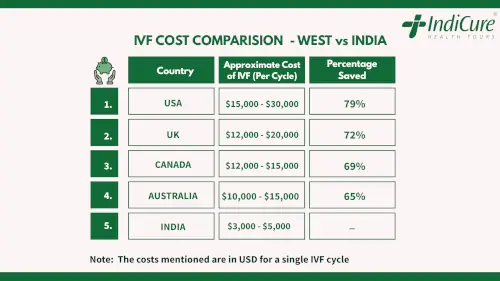
Note: The actual cost may vary based on the clinic, location, medication, and specific procedures.
Beyond the financial advantage, the Indian fertility landscape offers another crucial benefit: immediacy. Choosing to have fertility solutions in India allows many patients to start treatment without a long wait, and because age matters so much in fertility treatment, avoiding delay can matter.
Success rates vary widely with age, diagnosis and the clinic, and are reported in different ways - per cycle, per transfer, or cumulatively across several cycles. Ask any clinic for its live-birth rate per cycle for your own age group, and for how it defines success. Many Indian fertility specialists have trained at internationally recognized institutions, and India now treats a large number of international fertility patients.
The Foundation of Trust: A Regulated & Ethical Framework
A medical journey of this nature requires a foundation of trust. Fertility tourism in India has grown stronger because the country has proactively established a robust legal and regulatory framework to ensure the safety, ethics, and quality of its assisted reproductive technology (ART) services, directly addressing concerns about treatment abroad.
While India was once known as a hub for commercial surrogacy, the government has enacted strict legislation to curb unethical practices. The Assisted Reproductive Technology (Regulation) Act, 2021, and the Surrogacy (Regulation) Act, 2021, have established a robust framework for supervision, licensing, and ethical practices. It is important to note that commercial surrogacy is now strictly prohibited, and altruistic surrogacy is only legally available to married Indian citizens. This shift, while eliminating an option for foreign patients, demonstrates a powerful commitment to protecting vulnerable populations and elevates India's reputation as a safe and ethical destination.
A key marker of quality is international accreditation. Many leading Indian hospitals and clinics hold accreditations from prestigious global bodies like the Joint Commission International (JCI) and the National Accreditation Board for Hospitals & Healthcare Providers (NABH), a national accreditation built on international standards. Furthermore, many of the nation's top fertility specialists possess credentials from esteemed institutions and have extensive experience in the field.
| Advantages of Fertility Tourism in India | What It Means for You, as a Medical Tourist |
|---|---|
| Affordability | Save up to 80% on total treatment costs compared to Western countries, even with travel expenses factored in. |
| High Success Rates | Leading Indian clinics report outcomes in line with international practice, and will give you their own figures for your age group and diagnosis. |
| Short Waiting Times | Treatment can usually begin without the long waiting lists common in some countries. |
| Vetted Professionals | Leading hospitals are internationally accredited, and doctors are highly experienced and often globally trained. |
| Legal Framework | National laws license and regulate fertility clinics, giving you a regulated environment for your treatment. |
Your Partner in Parenthood: The IndiCure Advantage
The prospect of traveling to a new country for IVF can feel overwhelming. However, a well-defined plan and the right support can turn this daunting journey into a smooth and well-managed process. The first critical step is securing a medical visa. The Indian government has simplified this process with the e-Medical Visa, which can be obtained entirely online. The primary document required for this is an invitation letter from an accredited Indian hospital, which confirms the patient's need for the required treatment.
Navigating the practicalities of a medical trip for fertility in India requires careful planning. It is crucial to coordinate all logistics in advance, from booking flights to scheduling medical appointments. This is where a trusted medical tourism partner makes the experience far more manageable. IndiCure Health Tours takes on the practical side, handling all the complexities of medical travel so patients who are travelling to an overseas location can focus on their health and recovery.
The cornerstone of this service is a meticulous and personalized approach. IndiCure works with a carefully selected network of doctors and clinics that meet its quality criteria, and can show you each doctor's qualifications and experience. The company's associated clinics include hospitals with JCI or NABH accreditation.
IndiCure Health Tours provides comprehensive, end-to-end support that includes:
- All-Inclusive Packages: Clear, itemised pricing agreed before you travel, so you know what is covered and what is not.
- Dedicated Support: Patients receive a dedicated case manager who provides continuous "hand-holding" and personalized care from the initial consultation to the final departure.
- Coordinated Logistics: The company coordinates all travel arrangements, including airport pickups, accommodation, and a detailed schedule of appointments, so that your IVF journey runs smoothly.
- Honest Consultations: Patients can access free initial consultations and receive a direct, honest assessment of their situation without pressure.
- Post-Treatment Care: Support extends beyond the medical procedure, with coordination for post-treatment care, follow-up calls, and assistance with recovery.
The profound impact of this support is best captured in the voices of those who have experienced IndiCure services firsthand. Patients from Australia, New Zealand, Canada, and various African countries have described the experience as "seamless," "caring," and "life-changing". Testimonials of medical tourists highlight the feeling of being treated "like family" and the sense of security that comes with having a team that handles every detail. For many, this level of comprehensive care and compassionate guidance has turned a stressful medical trip into a journey of healing and hope.
Frequently Asked Questions about Fertility Tourism in India
-
How much can I save on IVF treatment in India?
The cost of an IVF cycle in India is significantly lower than in Western countries, making fertility tourism in India a highly cost-effective option. Patients can save up to 60-80% even after including travel and accommodation expenses. For example, a single cycle can cost between $3,000 and $5,000 in India, while the same procedure can cost between $12,000 and $15,000 in the USA, plus an additional $6,000 to $8,000 for medications, besides the additional cost of injections etc.
-
Are there any legal restrictions on foreigners seeking fertility treatment in India?
India has a strong regulatory framework with the Assisted Reproductive Technology (Regulation) Act, 2021, which ensures ethical and safe practices. While foreigners can access advanced fertility treatments like IVF, it's important to note that commercial surrogacy is now strictly prohibited, and altruistic surrogacy is only legally available to married Indian citizens.
-
What are the success rates for IVF in India?
Reported IVF success rates in India vary widely by clinic, by age and by how success is measured. Ask any clinic for its live-birth rate per cycle for your own age group, and for how it defines success - the figure moves a great deal depending on which measure is used.
-
What is the process for obtaining a medical visa for India?
The Indian government offers an e-Medical Visa that can be obtained online. The key documents required for the visa application include an invitation letter from the Indian hospital confirming the need for treatment, a passport with at least two blank pages, and proof of sufficient funds for your stay.
-
How can IndiCure Health Tours make my journey easier?
IndiCure acts as a dedicated medical tourism facilitator, providing comprehensive support that makes the process far simpler. The company handles all logistics, including vetting doctors and hospitals, coordinating travel and accommodation, and scheduling all medical appointments. This allows you to focus on your treatment and your well-being, knowing who is treating you, where, and what their training is.
Conclusion: The Journey to Your Miracle
The journey to parenthood is one of resilience, hope, and unwavering determination. For those facing the daunting obstacles of high costs, long waits, or a lack of local resources, fertility tourism in India represents a powerful opportunity. India's blend of world-class medical expertise, transparent and regulated practices, and a compassionate, patient-centric culture offers a viable path for fertility tourism. Select clinics and hospitals in India work to international standards within a regulated framework, at a fraction of the cost - which is why so many international patients now look here first.

The most challenging step is often the first—reaching out for help. By choosing a trusted medical tourism partner like IndiCure Health Tours, that step becomes easier: we will set out your options, what treatment involves and what it costs, so you can make the decision with your own doctors.
Contact IndiCure Health Tours today for a free consultation and personalized guidance on fertility tourism in India.
Visit www.indicure.com to learn more.